The $4,000 Same Day Implant Catch Clinics Hope You Never Read
Uncover the hidden charges behind low single-day dental implant offers, including unadvertised surgical preparation, temporary restoration fees, and federal coverage limits.
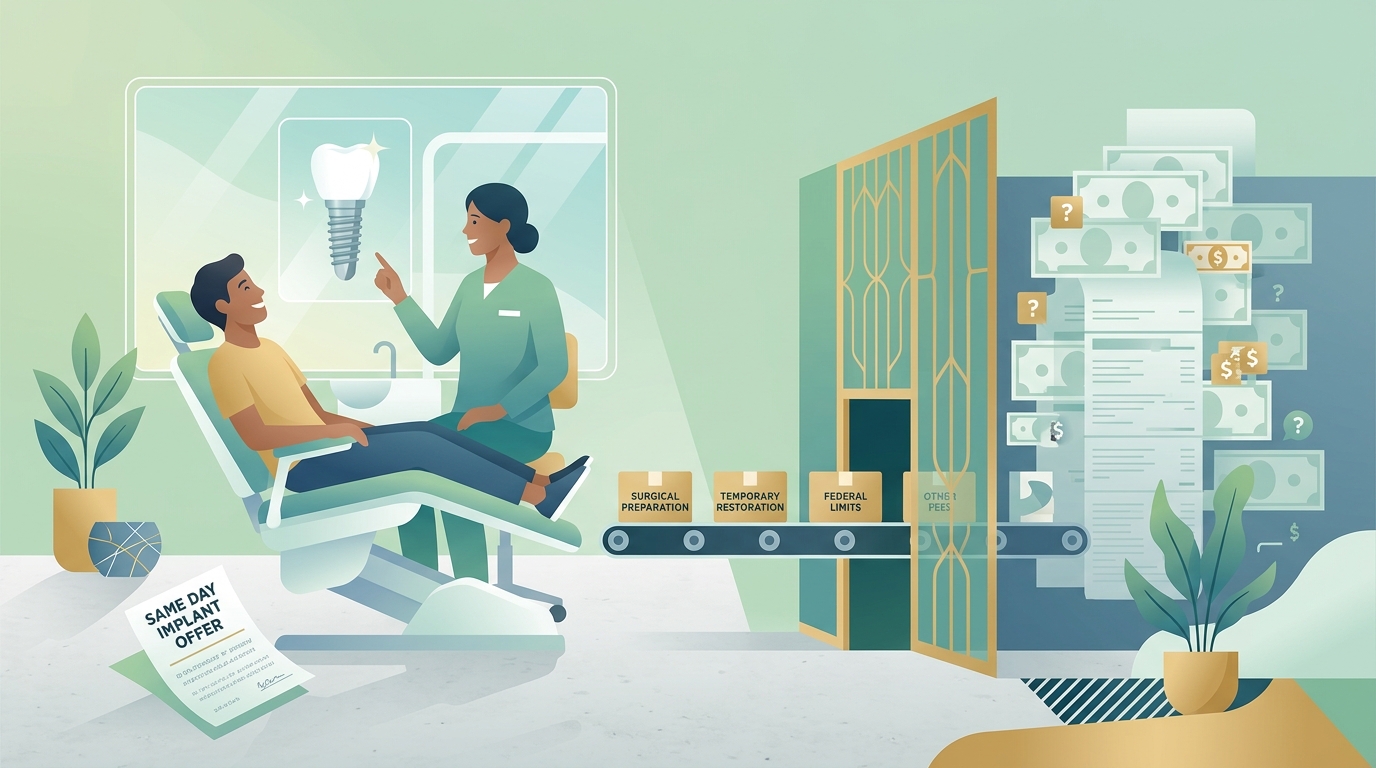
Promotional advertisements offering same-day dental implants for around $4,000 often capture the attention of patients seeking rapid, affordable tooth replacement. However, these advertised baseline figures frequently exclude critical surgical and prosthetic steps required to complete the procedure safely.
Understanding how dental clinics structure their billing models helps prospective patients identify fine-print disclosures before committing to treatment. By evaluating component breakdowns, pre-surgical necessities, and federal insurance restrictions, consumers can accurately calculate their true out-of-pocket expenses.
The Hidden Mechanics Behind Promoted Single-Day Rates
The primary catch of many $4,000 same-day implant promotions lies in the definition of same-day service. When clinics market single-day installations, the phrase typically refers only to the placement of the titanium implant post and a temporary acrylic crown. It rarely accounts for the final, permanent ceramic restoration that must be fabricated months later after osseointegration occurs.
Osseointegration is the biological process where bone cells attach directly to the implant surface, a phase that standard clinical timelines estimate takes three to six months. During this healing period, the temporary crown preserves space and appearance, but it is not engineered for long-term chewing forces. Patients are routinely surprised when billed separately for the final custom crown, which can add substantial fees onto the initial quoted promotional rate according to insurer fee schedules.
The Three Essential Implant Parts Billed Separately
A standard dental implant restoration consists of three distinct components, yet introductory promotional prices often bundle only one or two of them into the headline figure. To evaluate an offer accurately, patients must confirm whether the quote covers the entire structural assembly.
- The Implant Body (Post): The screw-like titanium or zirconia fixture inserted into the jawbone to act as an artificial root root structure.
- The Abutment: The connector piece attached to the top of the post that extends above the gumline to hold the replacement tooth.
- The Prosthetic Crown: The custom-molded artificial tooth that attaches to the abutment and matches the natural bite.
Industry billing surveys indicate that advertised single-price tags frequently cover only the implant post itself. The abutment and crown are often itemized separately on surgical proposals. When these individual component line items are added together, the final cost for a single-tooth replacement can double beyond the initial promotional hook.
Pre-Surgical Prep Work and Bone Density Requirements
Successful implant placement requires sufficient jawbone volume and healthy surrounding tissue to support the fixture under normal bite pressure (Source 4). When patients present with long-standing tooth loss or localized bone reabsorption, preliminary surgical preparation is required before an implant post can be safely anchored (Source 4).
These preparatory steps are almost never included in a $4,000 flat-rate advertisement. Supplemental procedures that generate additional billing codes include:
- Simple or Surgical Extractions: Removing damaged or non-restorable teeth prior to post placement.
- Bone Grafting: Adding natural or synthetic bone material to bolster jaw density before or during surgery.
- Sinus Lifts: Elevating the sinus floor in the upper jaw to create adequate height for post placement.
- 3D Cone Beam Imaging (CBCT): Advanced diagnostic scans required to map nerve paths and bone structure.
According to healthcare pricing databases, preparatory bone grafts and advanced diagnostic scans can add anywhere from several hundred to several thousand dollars to the overall treatment estimate, quickly overriding the advertised promotional rate.
Medicare Rules on Surgical Implant Coverage
Patients relying on federal healthcare coverage often assume Medicare will absorb a significant portion of dental implant fees. However, Original Medicare (Part A and Part B) maintains strict statutory exclusions regarding routine dental care and structural tooth restorations (Source 1).
Under standard Medicare guidelines, coverage for dental services is explicitly limited to narrow, non-routine circumstances where dental work is direct and integral to a covered medical procedure (Source 1). For instance, if a patient requires a jaw reconstruction following traumatic injury or oral cancer surgery, specific inpatient dental-related items may qualify for Part A or Part B consideration (Source 1).
Routine implant placement for missing teeth, age-related tooth loss, or cosmetic enhancement is excluded under Original Medicare guidelines (Source 1). Patients with Medicare Advantage (Part C) plans may receive supplemental dental benefits, but these private plans typically impose annual maximum benefit caps that cover only a fraction of total implant surgical expenses.
FDA Safety Regulations and Clearance Standards
Dental implants and their associated abutments are classified as medical devices subject to regulatory oversight by the U.S. Food and Drug Administration (Source 2). The FDA reviews dental implants to ensure materials are biocompatible and that manufacturing processes meet precise technical safety standards before commercial distribution (Source 2).
Regulatory clearance ensures that titanium and zirconia devices meet structural fatigue thresholds under functional biting pressures (Source 2). However, FDA regulatory clearance applies solely to device safety and effectiveness; it does not evaluate, endorse, or regulate clinic pricing structures, package deals, or consumer billing practices.
Consumers should confirm that any facility offering discounted single-day services utilizes FDA-cleared device systems rather than unapproved grey-market components designed to reduce clinic overhead costs.
FTC Rules Regarding Unclear Health Service Claims
The Federal Trade Commission enforces rules governing advertising practices to protect consumers against misleading claims in the healthcare marketplace (Source 3). Under federal regulations, commercial promotions must clearly disclose material terms, potential additional fees, and key restrictions before a transaction occurs (Source 3).
When a clinic advertises a headline price like $4,000 for same-day implants, FTC guidance dictates that any baseline qualifications—such as mandatory extra fees for abutments, impressions, or temporary crowns—must be prominently disclosed near the promotional claim (Source 3).
If an advertisement buries critical fee exclusions in tiny, illegible fine print or fails to state that the figure applies only to specific qualifying patients, the promotion may cross into deceptive marketing territory under federal oversight standards (Source 3).
Comparing Advertised Promotional Estimates to Total Expenses
To visualize how low promotional estimates expand during treatment, the table below illustrates typical itemized bill breakdowns based on consumer finance surveys and clinic billing schedules.
| Procedure Line Item | Promotional Quote | Typical Fee Schedule Range | Common Billing Conditions |
|---|---|---|---|
| Implant Fixture Placement | $4,000 | $1,800 - $3,000 | Covers surgical insertion of post only. |
| Custom Abutment Piece | Excluded | $500 - $1,000 | Billed separately at restoration phase. |
| Permanent Porcelain Crown | Excluded | $1,200 - $2,500 | Required 3-6 months after healing. |
| Pre-Op 3D Imaging (CBCT) | Excluded | $250 - $600 | Necessary for surgical placement mapping. |
| Bone Grafting / Extraction | Excluded | $400 - $2,000 | Required if jawbone density is low. |
| Total Estimated Expense | $4,000 Base | $4,150 - $9,100 Total | Varies by surgical complexity and location. |
Step-by-Step Actions to Protect Your Wallet Before Surgery
Patients considering same-day dental implant offers can avoid surprise billing statements by implementing a systematic verification strategy prior to consenting to surgical procedures.
- Request an ADA Itemized Estimate: Demand a written pre-treatment estimate utilizing American Dental Association (ADA) procedure codes for every step from extraction to permanent crown delivery.
- Separate Surgical and Prosthetic Costs: Ensure the quote explicitly details the price for the post, the abutment, the temporary restoration, and the final permanent crown.
- Clarify Preparation Fees: Ask directly whether diagnostic 3D imaging, tooth extractions, and bone grafting are included in the initial promotional rate.
- Verify Network Benefits: Confirm whether the attending oral surgeon and prosthodontist are in-network with your dental insurance provider to maximize policy allowances.
- Confirm Replacement Terms: Inquire in writing about clinic policies regarding implant failure, fixture refitting, or crown adjustments during the initial healing period.
Does Original Medicare pay for $4,000 same-day implant packages?
Original Medicare generally excludes routine dental care and implant procedures except when directly integrated into a broader covered medical treatment, such as facial reconstruction following surgery or injury (Source 1).
Are dental implants regulated for safety by federal health agencies?
Yes, dental implants and abutments are medical devices cleared and regulated by the FDA to ensure biocompatibility and structural safety standards (Source 2).
What should I do if a clinic omits key fees from an advertised price?
Under FTC guidelines, healthcare providers must avoid misleading fee advertising (Source 3). Request an itemized treatment estimate with ADA procedure codes before agreeing to treatment.
Sources
- Dental Services Coverage — Centers for Medicare & Medicaid Services
- Medical Device Products and Medical Procedures — U.S. Food and Drug Administration
- Health and Fitness Consumer Advice — Federal Trade Commission
- Oral Health Information — National Institute of Dental and Craniofacial Research
This article is for general information only and is not professional advice. Figures come from public sources and change over time; check the official source before you act.
More from Real Money Net
- The $0 Same Day Dental Implant Voucher Rule You Must Check
- The $3,500 Mistake People Make Requesting Same Day Implants
- The $4,000 Same Day Implant Catch Clinics Hope You Never Read
- Check If Your ZIP Code Qualifies For $0 Dental Implants Today
- Heat Pump HVAC Conversion Costs: Federal Rebates, Tax Credits, and System Sizing
- Business Fiber Internet vs. Dedicated Internet Access (DIA): Architecture, Cost, and SLA Comparison